
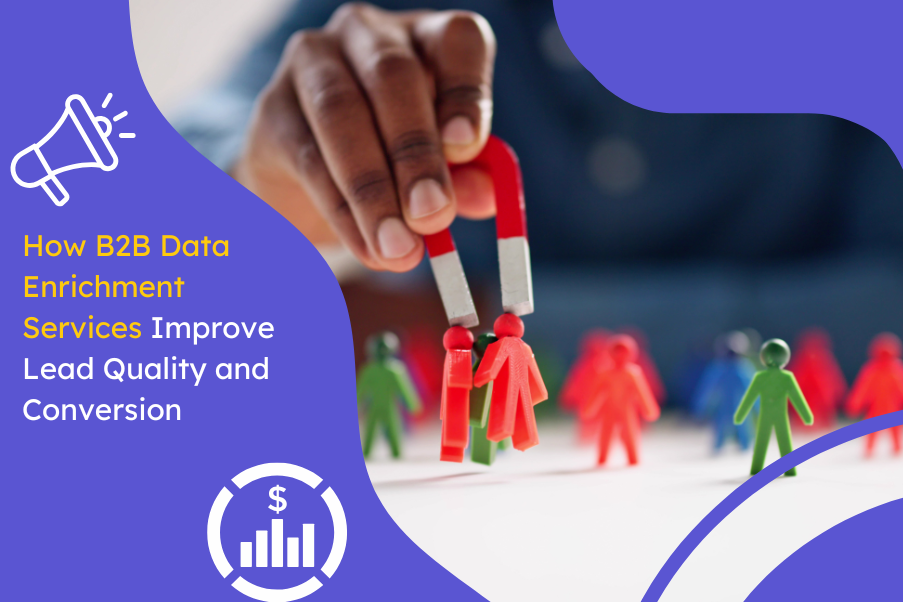
How B2B Data Enrichment Services Improve Lead Quality and Conversion
Most demand generation problems don’t start with weak campaigns. They start with weak data. Marketing teams invest heavily in targeting tools, creative assets, and automation platforms. Sales teams refine outreach sequences and pipeline workflows to support B2B Lead Gen initiatives. Yet despite these efforts, engagement stalls, conversions decline, and pipelines struggle to scale. The missing link is often data quality, which is why many organizations turn to B2B data enrichment services to strengthen their data foundations.
Incomplete, outdated, or inaccurate records quietly disrupt performance across the funnel. Campaigns reach the wrong audiences, emails fail to land in the right inboxes, and messaging lacks the context needed to resonate.
This is where B2B data enrichment services make a measurable difference by improving data accuracy, strengthening targeting, and turning information into a reliable driver of demand generation performance.
How Poor Data Quality Disrupts the Entire Demand Generation Funnel
Poor data rarely causes a single visible breakdown. Instead, it introduces friction across multiple funnel stages, gradually weakening performance in ways that compound over time.
One of the most overlooked realities in demand generation is how quickly data quality declines. Research shows that 70% of CRM data is outdated, incomplete, or inaccurate, meaning many organizations unknowingly operate with unreliable foundations without continuous support from B2B data enrichment services. When this happens, even strong campaign strategies struggle to deliver predictable results.
Inaccurate Targeting Leads to Wasted Campaign Spend
Targeting depends on reliable company-level and technology-level intelligence. Without it, even well-designed campaigns reach audiences that do not match the Ideal Customer Profile (ICP), weakening B2B Lead Gen effectiveness.
When these mismatches occur, marketing teams unknowingly invest resources into low-fit prospects. Budgets are distributed across organizations that lack the operational need, technical readiness, or purchasing authority required to convert. Over time, this reduces campaign efficiency and increases cost per lead while weakening overall pipeline quality.
This is where choosing the right B2B data solutions services becomes important, as verified and structured data helps teams avoid generic lists and focus on prospects that match the right company profile, need, and buying potential.
Perhaps more importantly, inaccurate targeting shifts sales focus toward accounts that lack true buying potential. Instead of concentrating on high-propensity prospects, teams spend valuable time chasing leads that rarely progress into opportunities. This is one of the core challenges addressed through B2B data enrichment services, which help refine targeting accuracy.
Outdated Contact Data Breaks Outreach Efforts
B2B ecosystems evolve continuously. Employees transition into new roles, departments restructure, and companies expand or pivot. Because of this constant movement, contact databases degrade faster than many teams anticipate without consistent updates supported by B2B data enrichment services.
Industry benchmarks indicate that B2B data decays at 2.1% per month, or 22.5% annually, meaning nearly a quarter of records may become unreliable within a year if not updated regularly.
Invalid email addresses increase bounce rates and negatively impact sender reputation across Email Marketing Services programs. Even when messages reach inboxes, they may land with individuals who no longer influence purchasing decisions. These breakdowns reduce response rates, slow engagement cycles, and weaken outreach productivity.
Over time, these issues erode trust between marketing and sales teams. When contact accuracy becomes unreliable, even well-designed outreach campaigns lose effectiveness before conversations begin.
Incomplete Lead Profiles Limit Personalization
Personalization depends on context. When prospect records lack meaningful attributes, such as role responsibilities, company structure, or technology environment, communication becomes generic even within structured Email Nurturing workflows.
Generic messaging rarely captures attention because it fails to address real operational challenges. Buyers expect relevance, and when that relevance is missing, engagement declines quickly.
This limitation is one of the most common reasons organizations adopt B2B data enrichment solutions, not simply to expand data volume but to increase the depth and usability of existing records through B2B data enrichment services.
What Are B2B Data Enrichment Services?
Personalization is often misunderstood as inserting names into emails. In reality, meaningful personalization depends on understanding business priorities, operational challenges, and role responsibilities, insights commonly enabled by B2B data enrichment services.
Enriched data provides this deeper insight. Role-level intelligence clarifies decision-making authority, while behavioral engagement signals reveal active areas of interest.
This level of understanding directly influences buyer confidence. Studies show that 81% of B2B buyers are more likely to purchase when sellers demonstrate a strong understanding of their business, highlighting the importance of contextual communication.
For example, a senior technology leader evaluating infrastructure scalability will prioritize system resilience and performance efficiency. In contrast, a marketing operations manager researching campaign tools will focus on workflow optimization and reporting visibility. Recognizing these differences allows communication to reflect real-world responsibilities rather than generic messaging.
Personalization also becomes more responsive when behavioral signals are incorporated. Website interactions, content downloads, and webinar participation indicate active research areas, enabling organizations to deliver relevant insights at the right time. These signals are especially valuable across content syndication initiatives where timing and relevance significantly influence engagement.
How B2B Data Enrichment Services Improve Targeting Accuracy
Effective targeting begins with a clearly defined Ideal Customer Profile. However, ICP alignment is only possible when prospect data reflects accurate and detailed attributes. This is where B2B data enrichment services provide measurable value by ensuring that segmentation decisions are based on reliable intelligence rather than assumptions.
Enriched datasets allow segmentation based on meaningful business signals such as company size, technology usage, market presence, and engagement behavior. These insights enable marketing teams to design campaigns that address the needs of high-fit organizations rather than broadcasting generic messages to broad audiences.
This shift from broad outreach to precision targeting creates measurable improvements. Campaign engagement increases, lead quality improves, and marketing budgets produce stronger returns. Many organizations achieve these gains by implementing structured B2B data enrichment solutions that support advanced segmentation and audience analysis.
More importantly, enriched segmentation enables organizations to identify high-propensity accounts, those most likely to convert based on both profile fit and behavioral indicators. Instead of relying on intuition, teams operate with evidence-based targeting strategies that concentrate effort where it matters most.
How Enriched Data Enables Personalization at Scale
Personalization is often reduced to inserting names into emails, but meaningful personalization requires a deeper understanding of prospect roles and priorities. Achieving this level of relevance consistently depends on reliable insights supported by B2B data enrichment services.
Enriched data provides this depth. Role-level intelligence clarifies decision-making authority, while behavioral engagement reveals active areas of interest. For example, a senior technology leader evaluating infrastructure scalability has different priorities than a marketing operations manager researching campaign tools. Understanding these distinctions allows messaging to reflect real-world responsibilities.
Personalization also becomes more dynamic when behavioral insights are included. Website interactions, content downloads, and event participation provide signals about what prospects are actively researching. These signals help organizations deliver relevant content at the right time rather than relying on static communication sequences.
This capability becomes especially valuable within structured email nurturing programs, where communication timing and relevance directly influence engagement quality.
As personalization becomes more precise, engagement improves naturally. Prospects respond more frequently, content consumption increases, and communication becomes more conversational rather than transactional.
How Data Enrichment Strengthens Lead Qualification
Lead qualification determines whether prospects progress into the pipeline or remain unproductive entries. This stage plays a critical role in maintaining consistent performance across revenue operations, particularly in organizations that rely on structured B2B appointment setting services.
When qualification relies on incomplete data, sales teams often evaluate leads that lack authority, readiness, or alignment with organizational goals. This slows pipeline movement and increases resource waste.
Enrichment strengthens qualification by introducing structured attributes that support advanced lead scoring models, a core benefit of B2B data enrichment services. These models evaluate both profile fit and engagement behavior. A prospect that closely matches ICP criteria and demonstrates active interest, such as attending webinars or interacting with content, represents a significantly stronger opportunity than one defined solely by company size.
This combined scoring approach enables teams to prioritize prospects based on probability rather than assumption. As a result, pipeline movement accelerates, and sales teams focus their attention on leads with measurable conversion potential.
The Downstream Impact: Better Data Drives Better Conversion Outcomes
Data enrichment delivers its greatest value when examining downstream engagement performance across demand generation channels.
Improved Email Marketing Performance
Email remains one of the most reliable engagement channels, but its effectiveness depends heavily on contact accuracy and segmentation precision.
With enriched datasets, communication lists contain validated recipients and relevant audience attributes. Messaging aligns with prospect needs, improving engagement quality across email Marketing services workflows.
These improvements typically lead to:
- Lower bounce rates
- Higher deliverability
- Stronger sender reputation
- Increased open and click-through rates
These improvements become stronger when data enrichment is connected with structured B2B Email Marketing Services. Verified contacts, better segmentation, and relevant messaging work together to improve engagement quality.
In addition, enriched behavioral signals allow organizations to identify high-intent prospects and route them to sales teams more efficiently. This prevents valuable leads from remaining inactive within automated workflows and strengthens long-term communication strategies.
More Effective Content Syndication Campaigns
Content Syndication programs rely on audience accuracy to produce meaningful results. Without precise segmentation, syndicated content may generate large volumes of low-quality leads that fail to convert into meaningful conversations.
Enriched datasets improve audience alignment by ensuring content reaches individuals and organizations that match defined ICP criteria. These outcomes are commonly achieved through mature B2B data enrichment services that continuously refine segmentation quality.
Behavioral insights further enhance relevance by identifying prospects who are actively researching solutions. This improves campaign efficiency by reducing irrelevant downloads and increasing the likelihood that syndicated leads will engage in follow-up conversations.
Higher Success Rates in B2B Appointment Setting
Appointment setting represents one of the most sensitive stages in the demand generation lifecycle. Without accurate contact validation and contextual insights, outreach teams struggle to initiate conversations with decision-makers.
With enriched profiles, outreach becomes more strategic. Verified communication channels, role-level intelligence, and engagement indicators improve message relevance and response timing. As a result, outreach cycles shorten, meeting acceptance rates increase, and pipeline progression becomes more consistent within structured B2B appointment setting services environment
Why Data Enrichment Should Be a Continuous Process
Data enrichment is not a single initiative but an ongoing operational requirement. Organizations that rely on B2B data enrichment services recognize that maintaining data accuracy requires consistent updates rather than periodic corrections.
B2B datasets naturally decay due to job transitions, company restructuring, and technology changes. Without continuous updates, segmentation accuracy declines and campaign performance becomes unpredictable.
Continuous enrichment ensures that prospect records remain aligned with real-world changes. It supports reliable targeting, improves operational consistency, and enables organizations to respond quickly to evolving market conditions.
Rather than reacting to performance issues after they occur, teams maintain stable data foundations that support sustained growth.
Best Practices for Implementing B2B Data Enrichment Solutions
Successful enrichment initiatives require structured planning and consistent execution. Organizations that approach enrichment strategically are more likely to maintain long-term data reliability and operational efficiency.
Define Your Ideal Customer Profile First
Before enrichment begins, organizations must establish clear ICP criteria. Without a well-defined ICP, enriched data may add volume without improving strategic alignment. ICP clarity ensures that new attributes strengthen segmentation, targeting accuracy, and qualification logic.
Standardize Data Fields Across Systems
Data consistency is essential for accurate segmentation and reporting. Standardizing naming conventions, formats, and required fields across CRM and marketing systems reduces duplication, improves automation reliability, and ensures enriched attributes integrate smoothly into workflows.
Integrate Enrichment Into Existing Workflows
Data enrichment should not function as a standalone process. It should connect directly with operational systems such as:
- CRM platforms
- Marketing automation systems
- Lead generation workflows
- Systems supporting ongoing B2B Lead Gen initiatives
Embedding enrichment into daily processes ensures records are updated continuously rather than periodically, maintaining real-time accuracy.
H3: Conduct Regular Data Audits
Routine data reviews help identify inconsistencies, outdated records, and structural errors before they affect campaign performance. Regular audits also support long-term governance practices that preserve data integrity across departments.
Turning Data Into a Revenue Driver Instead of a Backend Function
Data has traditionally been treated as an operational necessity rather than a competitive advantage. That perception is changing.
Modern demand generation depends on precision, and precision depends on accurate intelligence. Organizations that embed B2B data enrichment services into revenue strategy consistently outperform those that treat data as administrative infrastructure.
When enriched intelligence guides targeting and engagement decisions, marketing campaigns reach better audiences, sales teams engage stronger prospects, and pipeline quality improves. These gains accumulate over time, producing measurable improvements in conversion rates and revenue predictability.
Conclusion
Poor data rarely draws attention on its own, but its effects appear across every stage of demand generation, from missed connections to low engagement and inconsistent pipeline growth. When organizations invest in B2B data enrichment services, the benefits extend far beyond cleaner records. Targeting becomes sharper, personalization becomes more relevant, and lead qualification becomes more dependable. These upstream improvements drive stronger downstream outcomes across Email Marketing Services, Content Syndication, and B2B appointment setting services, ultimately strengthening pipeline performance and revenue predictability.
Organizations that treat data as a strategic revenue asset gain a measurable advantage in modern demand generation, because sustainable growth begins with the quality of the data behind every campaign.
Partner with PMG B2B to strengthen your data foundation and drive more reliable pipeline growth.